
Solar Farm Design Software Comparison: How to Choose the Right Tool for Your Projects

.jpg)
However, not all solar design software tools are built for the same purpose. Platforms optimized for residential and commercial projects often struggle to scale to utility-scale solar projects, while engineering-grade tools can be misaligned with early-stage feasibility and development needs.
In this article, we will walk through a solar farm design software comparison to help understand how different tools support utility-scale projects. We’ll look at software categories, key features such as shading analysis, 3D modeling, energy yield estimation, and financial modeling, and explain why PVFARM - an award-winning upstream, AI-powered platform - is redefining how utility-scale solar systems are planned and evaluated.
Why Solar Design Software Choice Matters More Than Ever
Solar projects are becoming larger, more complex, and more capital-intensive. Utility-scale developers are managing hundreds of megawatts - often gigawatts - across diverse terrain, grid constraints, and regulatory environments. And, at the same time:
- Land availability is tightening
- Grid interconnection requirements are increasing
- Financial models are under greater scrutiny
- Investors expect higher confidence earlier
This means solar design is no longer just about creating system layouts. It is about making early, data-driven decisions that shape energy production, cost, and risk across the entire project lifecycle.
The right solar design software enables teams to:
- Evaluate feasibility earlier
- Compare design trade-offs faster
- Generate more accurate energy production estimates
- Reduce downstream redesign and rework
Categories of Solar Design Software in the Market
Before comparing individual platforms, it’s important to understand the three major categories of solar design software used across the industry.
1. Residential & Commercial Sales-Driven Design Tools
Examples here include Aurora Solar, and other proposal-centric platforms commonly used in residential and commercial markets.
These tools are widely used by:
- Residential solar installers
- Small residential solar installers
- Mid-sized solar companies
- Solar sales teams
Primary Strengths:
- Fast proposal creation
- Customer-facing visuals
- Basic shading analysis
- Integrated sales process workflows
- Lead management and proposal generation
Limitations for Utility-Scale Solar:
- Designed for rooftops and small ground mounts
- Limited terrain handling
- Simplified system layouts
- Shading and energy modeling optimized for residential and commercial use cases
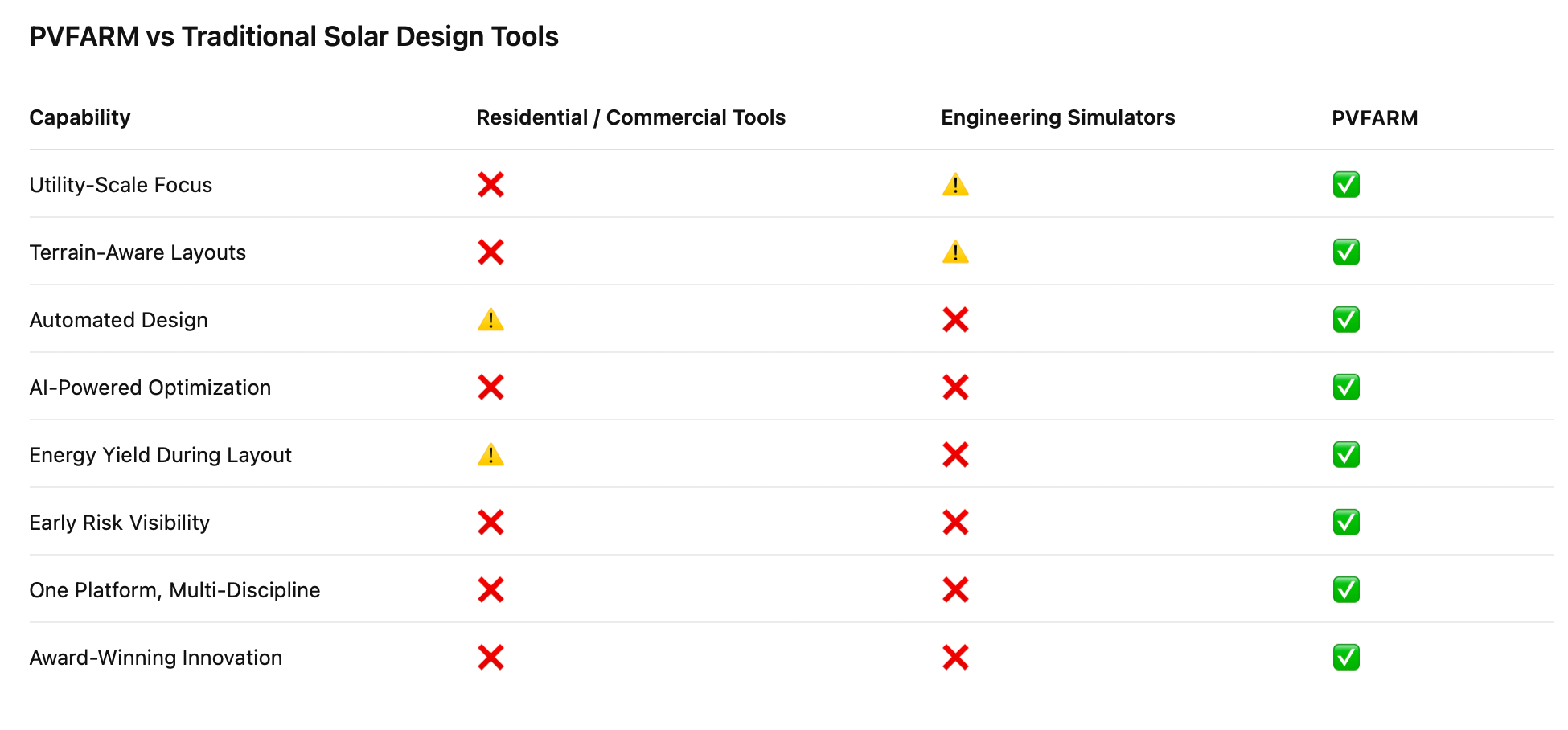
While these platforms are often considered the best solar design software for residential and commercial projects, they are not intended for utility-scale developers or engineering firms managing complex solar energy systems.
2. Engineering-Focused Simulation & CAD Software
Examples here include:
These tools are commonly used by:
- Solar engineers
- Engineering firms
- EPC technical teams
Primary Strengths:
- Detailed performance simulation
- Accurate energy simulations
- Electrical modeling
- Performance analysis and validation
Limitations:
- Slow iteration cycles
- Limited usability for early-stage development
- Disconnected from civil and layout constraints
- Often require finalized inputs to be meaningful
These tools are critical for validation and bankability, however, they are not designed to support rapid early-stage solar development or holistic design exploration.
3. Upstream Utility-Scale Solar Design Platforms
This is where PVFARM stands apart.
PVFARM is an AI-powered, web-based solar design platform built specifically for utility-scale solar development, and it has been recently recognized as an award-winning design platform for its impact on large-scale solar workflows.
Rather than focusing on proposal creation or late-stage validation, PVFARM operates upstream in the project lifecycle, bridging early-stage creativity with downstream execution.
What “Upstream” Solar Design Software Really Means
In the context of solar development, upstream refers to the earliest phases of the project value chain, where decisions have the greatest leverage over cost, energy yield, and risk.
PVFARM was developed explicitly to address the disconnect between early conceptual layouts and buildable reality.
Core Upstream Capabilities of PVFARM
Early-Stage Planning:
- Rapid feasibility assessment
- High-confidence energy yield estimates
- Early risk identification
Design & Layout Optimization:
- Automated system layouts
- Terrain-aware ground-mount design
- Optimized layouts at scale
- Accurate system layouts that reflect real constraints
Feasibility & Risk Assessment:
- Earthwork and grading impacts
- Pile and terrain risk visibility
- Electrical topology implications
- Energy production sensitivity
Collaboration Across Disciplines:
- One platform for development, engineering, finance, and construction stakeholders
- Shared project model
- Reduced conflict between teams
By operating at this early stage, PVFARM helps teams make smarter decisions earlier, before capital is committed and assumptions become fixed.
Key Features to Compare in Solar Farm Design Software
When evaluating solar farm design software, especially for utility-scale projects, comparisons should focus on capability depth, scalability, and decision quality, not just speed.
1. Layout & System Design
- Can the software generate accurate system layouts at scale?
- Does it support ground-mount utility-scale solar?
- Are layouts terrain-aware and grading-informed?
PVFARM delivers automated design that reflects buildable geometry, not idealized layouts.
2. Shading Analysis & Energy Modeling
- Is shading analysis detailed or simplified?
- Are terrain and self-shading modeled accurately?
- Are energy production estimates dynamic and scenario-based?
PVFARM integrates solar energy modeling directly into layout exploration, allowing teams to see how design changes affect energy yield instantly.
3. 3D Modeling & Terrain Intelligence
- Does the platform support advanced 3D modeling?
- Can it handle complex terrain across large sites?
- Are grading and slope constraints visible early?
PVFARM’s advanced 3D modeling is designed for utility-scale solar, not rooftops.
4. Financial Modeling & Energy Yield Impact
- Can design changes be linked to financial outcomes?
- Are energy yield changes visible early?
- Can teams evaluate comprehensive financial analysis inputs sooner?
PVFARM supports upstream inputs to financial modeling by improving early-stage energy and cost assumptions, giving teams greater confidence in ROI and LCOE before bankable studies are performed.
5. Workflow Efficiency & Scale
- Can teams iterate quickly across entire portfolios?
- Does the platform support scale projects efficiently?
- Is the entire design process centralized?
PVFARM supports workflow efficiency across the entire process, from feasibility through development handoff.
Who is PVFARM Designed For
PVFARM is built for:
- Utility-scale developers
- Solar engineers
- Engineering firms
- EPCs
- Utility-scale solar businesses
It is not a proposal creation tool, CRM, or sales platform - and that is intentional.
Instead, PVFARM empowers teams upstream with:
- Better system design
- More accurate layouts
- Earlier insight into performance and cost
- Fewer downstream surprises
How to Choose the Right Solar Design Software
When choosing the right solar design software, ask the following:
- What scale of projects are we designing?
- Do we need speed, accuracy, or both?
- Where do costly surprises typically occur in our workflow?
- Are early layouts buildable - or disposable?
- Do we need sales enablement or engineering confidence?
For residential and commercial solar installers, sales-driven tools may be sufficient. However, for utility-scale solar development, upstream design intelligence is no longer optional.
Why PVFARM Is Redefining Utility-Scale Solar Design
PVFARM has recently been recognized with an industry award for redefining early-stage utility-scale solar design. It identifies critical interdependencies early, helping teams mitigate project risk before issues escalate. By integrating layout, civil, electrical, and energy considerations into a single AI-powered design environment, PVFARM enables teams to design smarter, move faster, and build with confidence.
It doesn’t replace downstream engineering tools - it enhances their effectiveness by providing higher-fidelity inputs earlier in the workflow.
Choosing Software That Matches Your Project Reality
A solar farm design software comparison isn’t about finding a single “best” tool. Rather, it’s about choosing the right tool for the job.
As utility-scale solar projects grow in size and complexity, the industry is shifting upstream. Decisions made earlier now matter more than ever. We are proud that PVFARM is leading this shift, not as another solar design tool, but as a foundational platform for modern utility-scale solar development.
Connect With Us Today
If you’re evaluating solar design software for utility-scale projects and need clearer early-stage insight, faster iteration, and engineering-grade design context from day one, request a demo or speak with our team today to learn how PVFARM supports advanced design workflows.
.jpg)
.jpg)
.png)

.png)