
Solar Layout Software for EPCs and Developers: A Practical Guide

.jpg)
The result is often duplicated effort, longer design time, and late-stage redesign when build-ready projects collide with engineering reality.
In this blog, we examine the practical role of solar layout software for EPCs, developers, and manufacturers operating at utility scale. We explain how layout decisions materially influence energy production and project ROI; and we outline which capabilities are essential for delivering buildable, performance-optimized system designs. Finally, we explore why integrated solar design platforms, such as PVFARM, are reshaping the solar business by aligning engineering precision with commercial performance.
What Is Solar Layout Software?
Solar layout software enables teams to create system designs that position solar panels across a site while accounting for terrain, shading, setbacks, access roads, electrical infrastructure, and permitting requirements.
For utility scale projects, layout is not simply about placing panels. It must integrate:
- Terrain modeling and slope adaptation
- Row spacing and ground coverage ratio
- Shading analysis
- Tracker geometry and pile spacing
- Electrical block configuration
- Energy simulation inputs
Modern solar design software therefore serves as a specialized tool that connects geometry with performance and cost.
Why Layout Decisions Directly Affect ROI
In utility-scale solar projects, layout is inseparable from financial performance. For residential or commercial solar installations, layout errors might increase installation time or slightly reduce efficiency. However, for a 100 MW solar power plant, layout decisions can shift millions in capital cost.
Layout Influences Energy Production
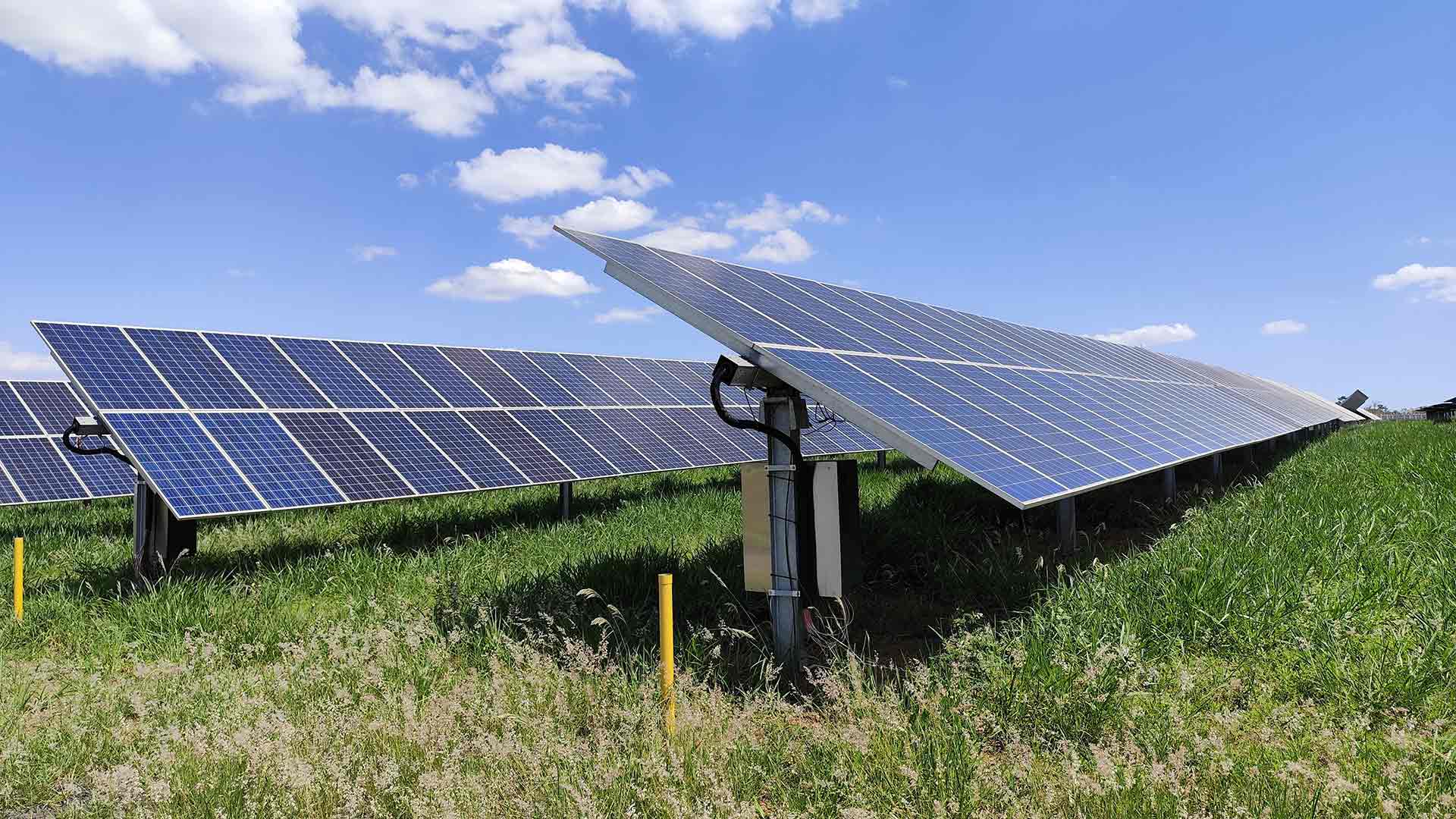
Solar energy systems depend on precise orientation, row spacing, and terrain adaptation.
Since revenue depends on how much energy the system produces, layout directly influences solar farm ROI. The configuration of solar panels determines:
- How much energy the system can produce
- How local weather patterns affect output
- How shading impacts efficiency
- Whether the system operates near peak efficiency
Even small spacing adjustments across thousands of individual modules can materially change annual energy production.
Layout Influences Cost
Layout also determines:
- Land requirement and grading volumes
- Cable lengths and trenching cost
- Inverter placement and balance of system design
- Access roads and construction sequencing
Optimizing one parameter without visibility into others can increase total cost. For example, compressing row spacing to increase density may increase shading and reduce energy production, undermining projected returns.
The Problem with Fragmented Workflows
Despite the scale and complexity of modern solar systems, many organizations still separate layout, engineering, and financial modeling into different tools.
A typical workflow might include:
- Prospecting software for early layout
- CAD tools for civil design
- Independent energy simulation platforms
- Spreadsheet-based financial analysis
Each handoff between tools introduces the risk of inconsistencies and modeling errors.
More critically, early-stage prospecting outputs often fail to account for real construction constraints. When engineering teams introduce pile embedment depths, tracker motor gaps, cable routing limitations, or grading realities, the original layout frequently must be rebuilt from scratch.
This creates delays, increases design time, and reduces confidence in early-stage cost and performance estimates.
What EPCs, Developers & Manufacturers Should Look for in Solar Layout Software
Choosing the right solar layout software requires understanding what capabilities are essential for utility scale.
Before reviewing features, EPCs should ask:
- Does the software model buildable reality?
- Does it integrate civil and electrical constraints?
- Does it support financial analysis?
- Can it adapt to different types of terrain?
- Does it reduce design errors rather than just visualize layouts?
Critical Features for Utility Scale Projects
High-quality solar design software should provide:
- 3D terrain modeling with accurate slope handling
- Integrated shading analysis
- Real-time energy simulation
- Support for fixed tilt and tracker systems
- DC:AC ratio testing
- Layout optimization tools
- Cable routing visibility
- Accurate modeling of individual modules
- Plan set export for permitting
- Fast iteration without manual redrawing
These features are not optional - they are critical for delivering profitable projects at scale.
Why Solar Layout Software Must Extend Beyond Layout
It is important to recognize that not all solar layout software operates at the same level.
PVFARM is more than a layout tool. While layout modeling is a core capability, the platform functions as an integrated design and optimization environment purpose-built for utility-scale projects. Rather than treating layout as a drafting task, it unifies engineering and commercial workflows within a single system.
To understand the distinction, it helps to examine how PVFARM extends beyond conventional layout software.
1. Integrated Engineering-Grade Layout and Civil Modeling
Traditional layout tools generate geometric plans. However, utility-scale projects require buildable accuracy.
PVFARM incorporates:
- Terrain contours and grading logic
- Pile spacing constraints
- Actual tracker geometry and motor gaps
- Constructability parameters affecting installation cost
By embedding these constraints from the outset, layouts reflect engineering reality. The result is a design that can move directly toward permitting and construction without fundamental rework.
2. Electrical System Modeling Within the Layout
Electrical design is often developed separately from geometry, creating disconnects that surface late in the process.
PVFARM integrates:
- Cable routing visibility
- Inverter placement and block sizing
- DC:AC ratio optimization
- Collection system planning
This bridges the gap between layout and electrical balance of system (BoS), reducing the risk of cost escalation once detailed engineering begins.
3. Integrated Energy Modeling and Simulation
Layout choices must be evaluated in the context of performance.
PVFARM links layout directly to energy simulation by incorporating:
- Shading analysis
- Irradiance data and local weather patterns
- Tracker versus fixed-tilt comparisons
- Module orientation effects
This allows teams to quantify how layout adjustments affect annual energy production before committing to a design.
4. Financial and Performance Optimization
For EPCs, developers and manufacturers, layout is a financial decision as much as a geometric one.
PVFARM enables teams to evaluate:
- The impact of DC:AC ratio on LCOE
- Energy production versus capital cost trade-offs
- Sensitivity of payback and IRR
By connecting layout to financial analysis, the platform turns design decisions into measurable economic outcomes.
5. Rapid Scenario Iteration
Utility-scale projects evolve quickly due to permitting constraints, land use changes, or interconnection limits.
PVFARM supports:
- Scenario comparison
- Automated optimization loops
- Real-time parameter adjustments
This dramatically reduces design time compared to exporting layouts across multiple other tools.
6. A Unified Platform Instead of Fragmented Tools
Rather than transferring geometry between CAD, energy modeling software, and financial spreadsheets, PVFARM unifies:
- Geometry
- Civil constraints
- Electrical infrastructure
- Energy performance modeling
- Financial evaluation
This reduces errors and avoids late-stage redesigns caused by disconnected workflows.
This integrated approach is one reason PVFARM received a Best-in-Show award in the software category of the 2025 Top Products contest, recognized for empowering teams to design smarter, move faster, and build with confidence.
How Layout Software Supports the Solar Business
While layout modeling is engineering-led, it also affects commercial performance.
For developers and commercial teams, high-quality solar layout software helps:
- Deliver faster proposals
- Provide accurate system designs
- Improve permitting confidence
- Reduce risk during the sales process
- Close more deals
In residential or commercial solar installations, sales reps may use a sales mode to quickly generate roof-based layouts and estimate electric bill savings. At utility scale, the same principle applies - faster, more accurate modeling accelerates capital allocation decisions.
Speed enables growth. Accuracy protects profitability.
The Role of Energy Simulation and Solar Data
Solar layout decisions must be grounded in reliable solar data.
Effective platforms, such as PVFARM, integrate:
- Historical irradiance data
- Local weather patterns
- Temperature effects
- Soiling assumptions
- Degradation modeling
Without accurate energy simulation, financial analysis becomes guesswork.
From Concept to Build-Ready Projects
Ultimately, solar layout software determines whether solar projects are:
- Efficient
- Permittable
- Constructable
- Bankable
Solar farms require careful integration of engineering detail and financial logic. Without that integration, early-stage layouts risk being discarded when confronted with construction realities.
By exposing hidden interdependencies early - such as how adjusting tracker selection influences grading volumes or how inverter positioning affects cable routing - PVFARM helps teams optimize the entire project rather than isolated components.
Layout Software as a Strategic Asset
Solar layout software sits at the intersection of engineering precision and financial performance. For EPC contractors, developers and manufacturers operating in a competitive global solar market, it determines whether solar systems are efficient, buildable, and profitable.
Fragmented workflows create delays, errors, and cost overruns. Integrated platforms eliminate the gap between concept and construction.
By unifying layout, civil engineering, electrical modeling, energy simulation, and financial optimization in one environment, PVFARM enables solar professionals to:
- Design faster
- Adapt to real-world site constraints
- Model energy production accurately
- Reduce late-stage surprises
- Deliver profitable, bankable solar projects
Connect With Us Today
If you are designing or delivering utility-scale solar projects, see how PVFARM transforms solar layout modeling for EPCs, developers and manufacturers. Request a demo today to explore integrated solar design built for speed, scale, and engineering accuracy.
.jpg)
.jpg)
.png)

.png)